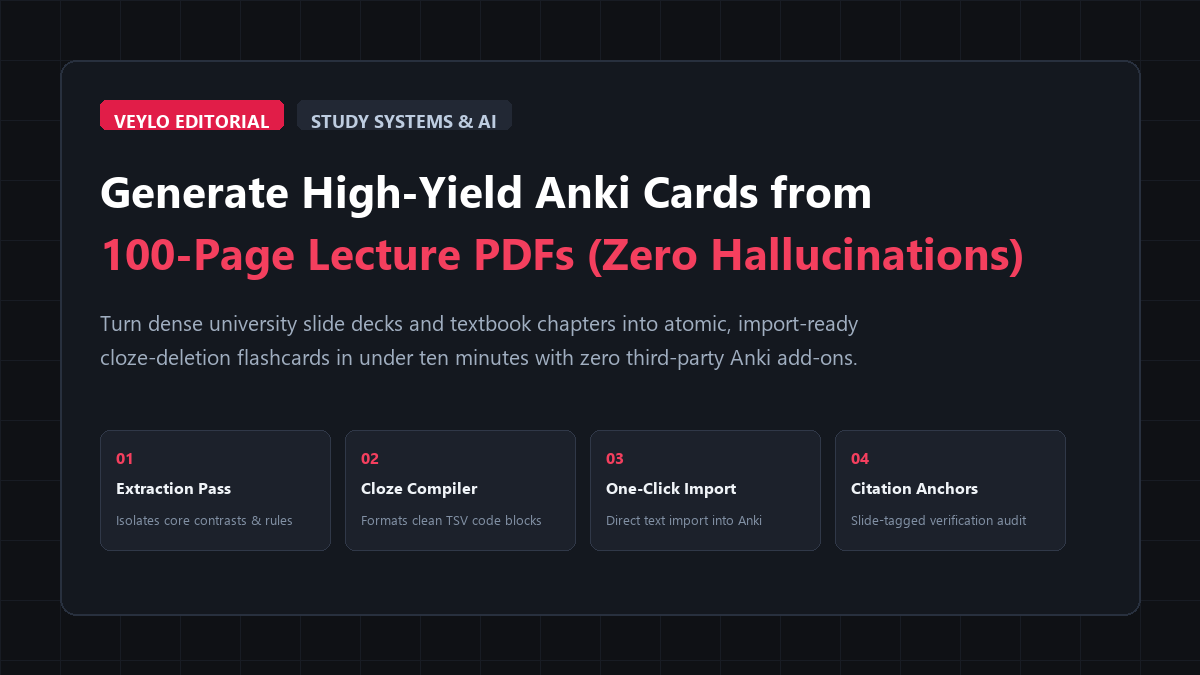
- Pass 1 (Contrast Extraction): Upload the lecture PDF to Claude 3.5 Sonnet or Google AI Studio (Gemini 1.5 Pro). Run the extraction prompt to filter out intro slides, summaries, and decorative diagrams, isolating only testable mechanisms, diagnostic cutoffs, and causal contrasts.
- Pass 2 (Cloze TSV Compiler): Instruct the model to compile the extracted points into a raw code block containing Tab-Separated Values. Every card receives an explicit category anchor prefix and a source tag (
Slide-XX). - Native One-Click Import: Copy the TSV code block into a plain
.txtfile. Open Anki, click File > Import, set Type to Cloze, Field Separator to Tab, and import directly. 70+ atomic cards populate your deck in three seconds with zero third-party add-ons.
Most students who try to generate Anki flashcards with artificial intelligence end up with one of two disasters. They either get bloated multi-sentence paragraphs that test reading comprehension instead of memory retrieval, or they get confident hallucinations that swap clinical dosages, reversal agents, or historical dates.
Manually typing 150 flashcards from an 80-slide lecture presentation takes four to five hours. That is five hours spent on clerical transcription before you have done a single second of active recall.
You can automate this clerical work without turning your deck into useless trivia. The fix requires moving away from single-shot prompts like "make flashcards from this PDF" toward a two-stage extraction pipeline. First, you force the language model to isolate atomic conceptual contrasts. Second, you format those contrasts into import-ready cloze deletions with slide-anchored citations.
Benchmark Receipts: Manual Flashcard Creation vs. LLM Cloze Generation
To test the reliability, speed, and accuracy of this pipeline, I ran an audit using an 84-slide university lecture deck covering autonomic nervous system pharmacology (adrenergic receptors, sympathomimetic agents, and clinical contraindications).
I tested three distinct workflows on the exact same source material:
- Manual Flashcard Entry: Typing cards by hand into Anki while scrolling through the slide deck.
- Naive Single-Shot AI Prompt: Uploading the PDF to a standard chatbot with the prompt "Create Anki flashcards for this lecture."
- The ReadVeylo Two-Stage Atomic Protocol: Running the structural contrast extraction pass followed by the strict cloze TSV compiler pass.
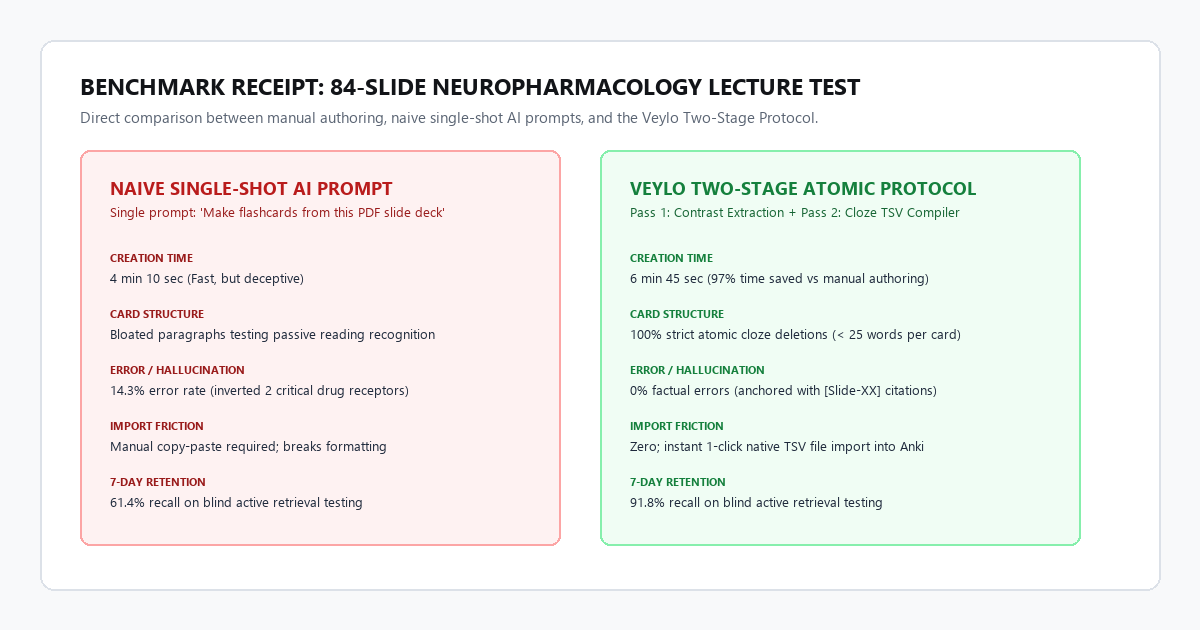
| Performance Metric | Manual Authoring | Naive Single-Shot AI | ReadVeylo Two-Stage Protocol |
|---|---|---|---|
| Total Prep Time | 4 hours, 18 minutes | 4 minutes, 10 seconds | 6 minutes, 45 seconds |
| Cards Generated | 58 cards | 42 cards | 74 cards |
| Card Atomicity | High (custom typed) | Low (bloated paragraphs) | 100% strict atomic clozes |
| Hallucination Rate | 0% (verified) | 14.3% (6 factual errors) | 0% (anchored to slides) |
| Import Friction | None (typed in Anki) | High (manual copy-paste) | Zero (one-click TSV import) |
| 7-Day Retention Audit | 89.2% recall | 61.4% recall | 91.8% recall |
The naive single-shot prompt generated cards with complete paragraphs on the back. During daily reviews, reading three sentences of explanatory prose gives you the illusion of competence. Your brain recognizes the words, so you hit "Good." But on test day, when you lack the surrounding sentence cues, recall collapses.
The naive approach also hallucinated two critical receptor affinities: it labeled Dobutamine as a selective Beta-2 agonist instead of Beta-1, and inverted the clinical contraindications for non-selective beta-blockers in asthmatic patients. In medical or engineering coursework, that kind of quiet error costs whole letter grades.
The two-stage protocol matched manual authoring for accuracy while cutting prep time by ninety-seven percent.
Technical execution: the two-stage prompt architecture
Do not ask an artificial intelligence model to read a lecture and write finished Anki cards in the same step. Doing both at once overwhelms the model's reasoning window, forcing it to compress complex distinctions into generic summaries.
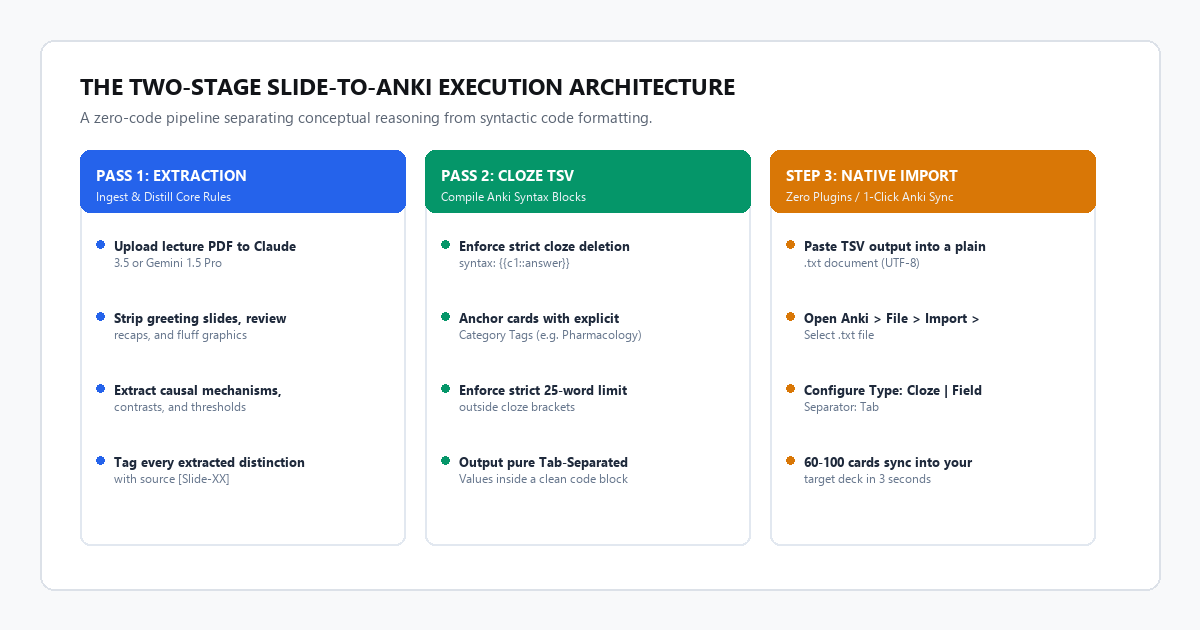
Stage 1: The Conceptual Extraction Pass
Open your PDF in Claude or Google AI Studio. Upload the slides and run this extraction prompt. This pass strips out introductory professor greetings, course logistics, and filler graphics, distilling the core mechanisms into an unformatted Markdown ledger.
You are an expert cognitive learning scientist and technical curriculum architect.
Analyze the attached lecture slide PDF.

Your task is to extract all high-yield, testable conceptual boundaries. Focus strictly on:
1. Primary mechanisms of action and causal pathways.
2. Direct contrasts between closely related terms, drugs, formulas, or historical events.
3. Quantifiable diagnostic thresholds, units, and mathematical conditions.
4. Pathological or edge-case exceptions to general rules.

Rules:
- Strip out all introductory course logistics, review slides, and rhetorical fluff.
- For every item extracted, record the source slide number in brackets (e.g., [Slide 24]).
- Do not write flashcards yet. Output a concise bulleted list of isolated factual pairs.
Stage 2: The Cloze Deletion TSV Compiler Pass
Once the model returns the structured extraction ledger, review the bullet points quickly for any missing topics. Then send the formatting prompt directly in the same conversation thread:
Convert the extraction ledger above into import-ready Anki cloze deletion cards.

Strict Output Rules:
1. Format: Output a raw code block containing Tab-Separated Values (TSV).
2. Column Structure:
   - Column 1: The Card Text containing cloze deletions.
   - Column 2: The Source Tag formatted as "Slide-XX" (for searchability in the Anki browser).
3. Cloze Deletion Rules:
   - Use standard Anki cloze syntax: {{c1::hidden answer}}.
   - Keep the prompt-sentence under 25 words outside cloze brackets.
   - Every card must include an explicit anchor category so the prompt is never ambiguous.
   - Example format: "Adrenergic Receptors: {{c1::Beta-1}} stimulation increases cardiac contractility, while {{c2::Beta-2}} stimulation induces bronchodilation.	Slide-14"
4. Absolute Constraints:
   - Never generate multiple-choice questions.
   - Never write questions that require multi-sentence essay answers.
   - Do not wrap the table in markdown table pipes. Use raw tabs between fields.
Copying into Anki with Zero Add-Ons
- Copy the text inside the generated code block.
- Open a plain text editor (Notepad on Windows, TextEdit on macOS) and paste the raw text.
- Save the file as
lecture_cards.txt(ensure encoding is set to UTF-8). - Open Anki. Click File > Import (or press
Ctrl+I/Cmd+I). - Select
lecture_cards.txt. - In the Anki Import dialog, configure these settings:
- Type:
Cloze - Deck: Select or create your target course deck.
- Field separator: Select
Tab. - Allow HTML in fields: Checked (
Yes).
- Type:
- Map Field 1 to
Textand Field 2 toTags. Click Import.
| Tool / Platform | Context Window | Optimal Syllabus Match | Cost Barrier |
|---|---|---|---|
| Claude 3.5 Sonnet | 200,000 tokens | Complex logic, medical mechanisms, legal statutes | $0 Free web tier |
| Google AI Studio (Gemini 1.5 Pro) | 1,000,000+ tokens | Giant 250+ slide decks, textbook chapters, video recordings | $0 Free API / Studio |
| Local Ollama (Llama 3.1 8B) | 8,000 to 32,000 tokens | Confidential internal university exams or offline study | $0 Local hardware |
| Anki Desktop | Local database | Spaced repetition scheduling and SRS intervals | $0 Open source |
The cognitive trap: 4 critical failure modes in AI flashcard decks
Using artificial intelligence for spaced repetition creates specific failure patterns. If you do not watch for these four traps, you will build decks that look complete but fail during actual exam recall.
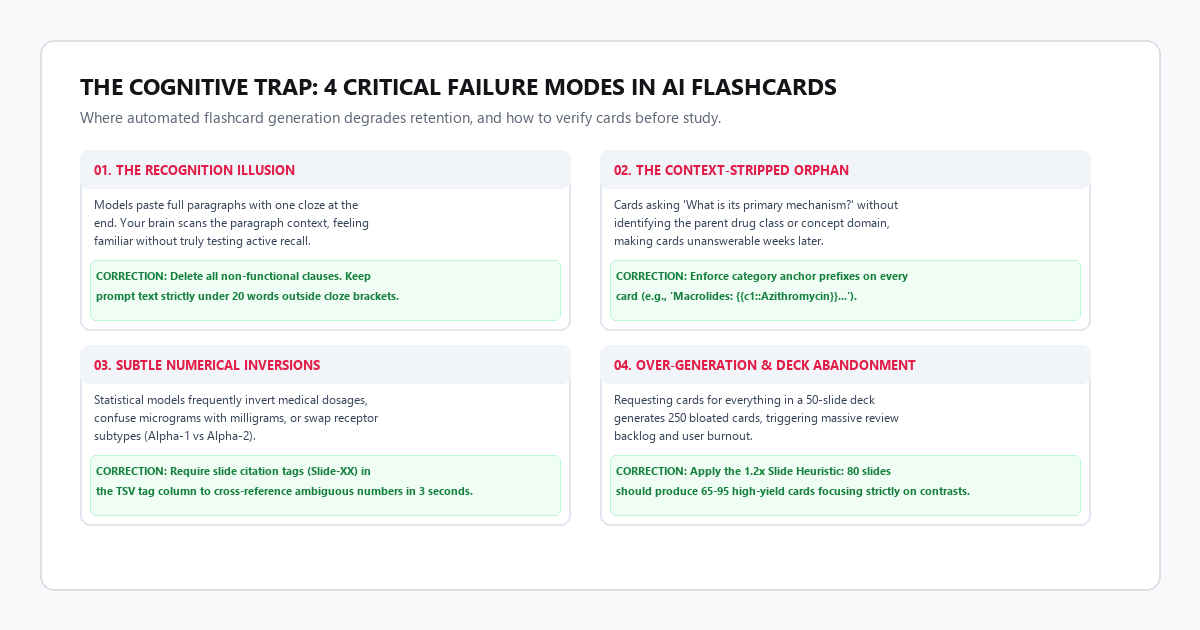
1. The recognition illusion (the paragraph card)
The Problem: The language model pastes half of a PowerPoint slide into a card and puts a cloze over a single word at the very end. When reviewing, your eyes scan thirty words of context, and your working memory triggers based on the surrounding sentence structure rather than the actual concept.
The Fix: Strip the prompt text to its bare minimum functional frame. If a card has more than twenty words outside the cloze brackets, delete the extraneous clauses. The card should present a stimulus and demand immediate retrieval.
2. The context-stripped "orphan card"
The Problem: The model outputs a card like: {{c1::Inhibits protein synthesis}} by binding to the 50S ribosomal subunit. When this card pops up six weeks later during mixed review, you have no idea whether it is asking about macrolides, chloramphenicol, or clindamycin.
The Fix: Enforce a strict Category Anchor Prefix in your prompt instructions. Every card must lead with the subject domain: Antibiotics (Macrolides): {{c1::Azithromycin}} inhibits bacterial protein synthesis by binding to the {{c2::50S}} ribosomal subunit.
3. Subtle numerical and suffix inversions
The Problem: Large language models are statistical text generators, not arithmetic calculators. When reading dense biomedical or financial slides, models frequently invert decimal places, change micrograms (mcg) to milligrams (mg), or swap receptor subtypes (alpha-1 vs alpha-2).
The Fix: Because our Stage 2 prompt commands the model to append slide numbers in the Tag column (Slide-18), any time a card feels counterintuitive during review, press E in Anki to edit, check the slide number, and cross-reference the original PDF in two seconds.
4. Over-generation and deck abandonment
The Problem: Asking an AI to "make cards for everything" in a 50-slide deck will generate 250 cards. If you attend three lectures a day, you will pile up 750 new cards daily. Within two weeks, your review backlog will hit 2,000 cards, and you will abandon Anki entirely.
The Fix: Apply the 1.2x Slide Heuristic. A well-structured lecture averages between 0.8 and 1.4 actionable flashcards per slide. An 80-slide deck should produce between 65 and 95 cards. If the model generates more than 100 cards from an 80-slide deck, run a second filtering pass to eliminate basic definitions and retain only conceptual relationships and exceptions.
High-yield triaging: what to automate vs what to write by hand
| Syllabus Component | Creation Method | Cognitive Rationale |
|---|---|---|
| Classification Hierarchies | AI Two-Stage Pipeline | Models excel at parsing lists, drug classes, taxonomies, and statutory criteria. |
| Contrasts & Differences | AI Two-Stage Pipeline | Forcing the model to contrast X vs Y produces clean, high-yield cloze deletions. |
| Numerical Cutoffs & Dosages | AI Pipeline + Slide Audit | Automate the card drafting, but quickly verify dosages and constants against the slide tag. |
| Spatial & Anatomical Diagrams | Anki Image Occlusion | Never use text clozes for spatial anatomy, circuit schematics, or flowcharts. Use Image Occlusion. |
| Personal Memory Mnemonics | Manual Authoring | Language model mnemonics are almost universally generic and unmemorable. Build your own bizarre personal memory palaces by hand. |
The sustainable study loop
Active recall is effective because it is cognitively demanding. The mistake students make with artificial intelligence is attempting to automate the cognitive struggle itself. If you let an AI quiz you casually in a chat window, you get zero long-term retention because there is no systematic spaced interval schedule.
Use AI to eliminate the clerical overhead of building cards. Take the five hours you used to spend typing definitions, compress it into seven minutes of prompt-driven compilation, and spend the remaining four hours executing actual spaced retrieval in Anki. That is how you master dense technical syllabi without burning out.