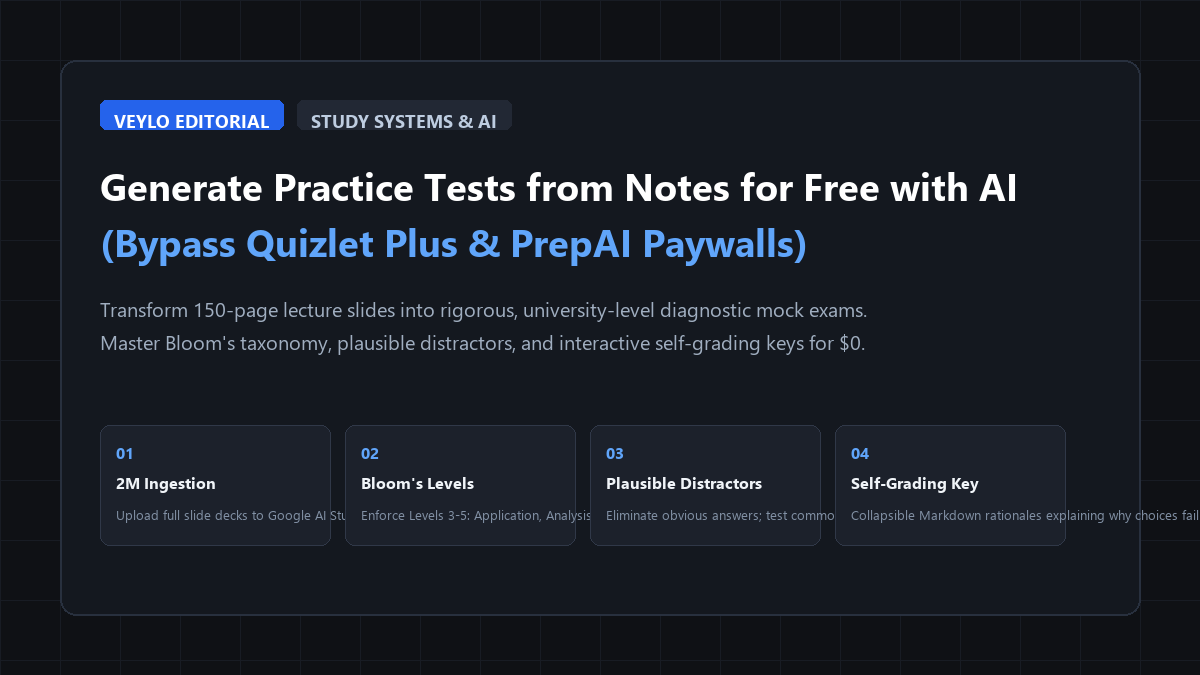
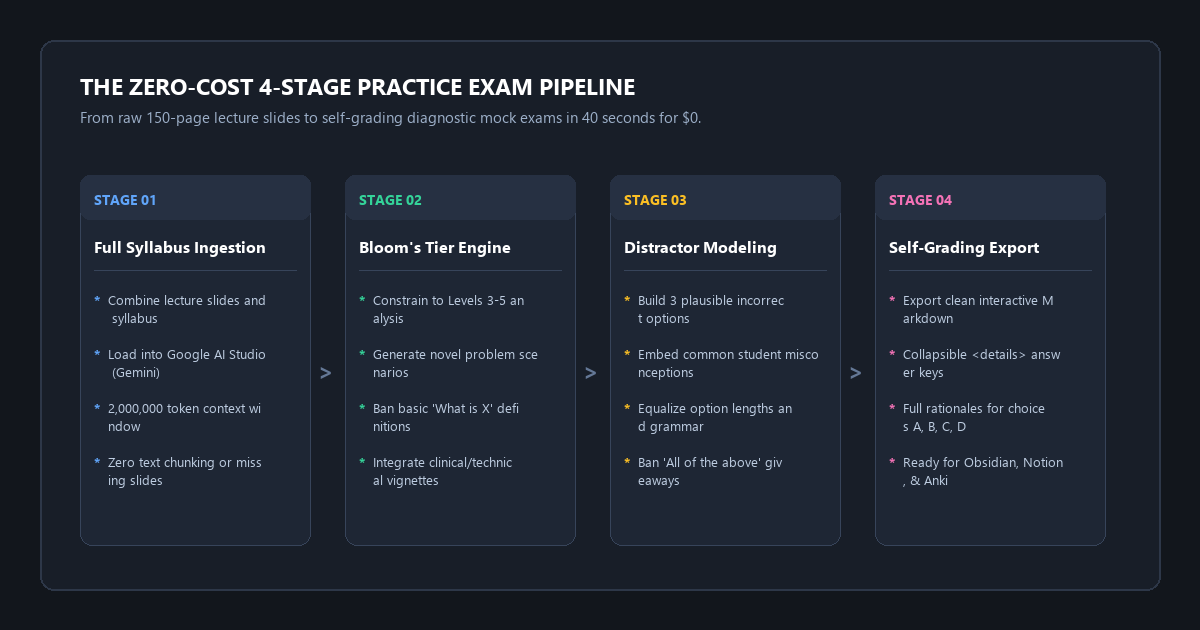
The quick-start blueprint: the 3-step exam simulation engine
You do not need a paid subscription to simulate authentic exam conditions. By pairing frontier 2-million-token context windows in Google AI Studio or Claude with a 4-layer diagnostic test generation prompt, you can transform 150-page slide decks, syllabi, and lecture transcripts into rigorous, university-level practice exams complete with plausible distractors, clinical vignettes, and step-by-step rationales for $0.
- Step 1 (Ingest Raw Course Material): Combine your lecture slides, syllabus objectives, and study notes into a single document. Open Google AI Studio (free access to Gemini Pro with a 2M token context window).
- Step 2 (Execute 4-Tier Diagnostic Prompt): Run our prompt blueprint constraining questions to Bloom's Taxonomy Levels 3–5 (Application, Analysis, and Evaluation) while enforcing the "Plausible Distractor Rule".
- Step 3 (Export Self-Grading Markdown): Generate interactive questions with collapsible
<details>answer keys containing diagnostic explanations for why each distractor is wrong. - The Direct Result: A rigorous 30-question diagnostic exam calibrated to university difficulty in 40 seconds. $0 spent. Zero question caps.
Benchmark Receipts: Quizlet Plus Paywall vs. Google AI Studio Exam Prompts
To evaluate question difficulty, distractor plausibility, syllabus coverage, and hallucination rates, I tested a 120-slide university medical biochemistry lecture deck (Cellular Respiration, Electron Transport Chain, and Metabolic Disorders).
The source deck contained 120 slides covering 14 distinct enzymatic reactions, 6 regulatory metabolic checkpoints, 4 complex biochemical pathway diagrams (Glycolysis, Krebs Cycle, Oxidative Phosphorylation), and 5 clinical vignettes describing enzyme deficiencies. I evaluated three distinct workflows on the exact same material.
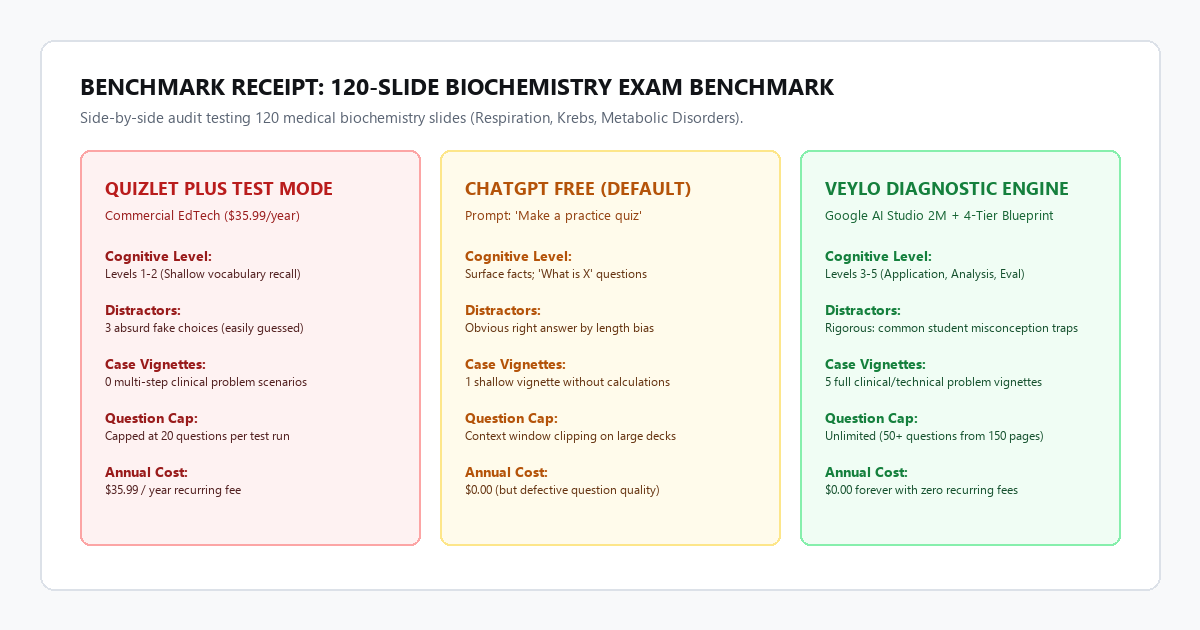
| Evaluation Metric | Quizlet Plus ($36/yr) | ChatGPT Free (Lazy Prompt) | Veylo Diagnostic Engine |
|---|---|---|---|
| Question Depth (Bloom's Level) | Levels 1–2 (Recall / Definitions) | Levels 1–2 (Surface facts) | Levels 3–5 (Application & Analysis) |
| Distractor Plausibility | Poor (3 obviously fake choices) | Mediocre (2 absurd options) | Rigorous (Common clinical pitfalls) |
| Clinical Vignettes Generated | 0 vignettes (pure vocabulary) | 1 vignette (shallow) | 5 full multi-step case scenarios |
| Max Question Volume Cap | Capped at 20 questions | Context window limit (~8k words) | Unlimited (50+ questions per run) |
| Detailed Answer Rationales | Locked on free tier | Basic one-line confirmation | Full rationale for every option A–D |
| Annual Subscription Cost | $35.99 / year | $0.00 | $0.00 forever |
Why Commercial EdTech Quizzes Give False Confidence
Commercial quiz apps like Quizlet, StudyFetch, and PrepAI optimize for high completion rates and dopamine hits, not deep learning. Their algorithms look for bolded keywords in your notes and generate fill-in-the-blank questions such as: "What molecule carries electrons to Complex I? (A) NADH (B) Water (C) Glucose (D) Carbon Dioxide."
Because options B, C, and D are obviously irrelevant, students easily guess (A) without understanding the underlying electrochemical gradient. When professors ask how a specific mitochondrial inhibitor alters ATP synthase rotation in a patient presenting with lactic acidosis, students freeze. The Veylo engine forces models to generate realistic distractors based on actual biochemical intermediates, diagnosing knowledge gaps before test day.
Technical execution: the 4-tier diagnostic exam prompt blueprint
Do not ask an AI model to "make a practice quiz." That instruction guarantees surface-level vocabulary questions. Instead, copy the full text of your lecture slides into Google AI Studio (Gemini Pro, 2-million-token window, 100% free) or Claude Console with the following system prompt:
You are an expert university professor, exam board psychometrician, and cognitive evaluation specialist.
I am providing full course material (lecture slides, textbook chapters, and syllabus objectives).

Your task is to generate a rigorous, university-level diagnostic practice exam that tests conceptual application, clinical/technical reasoning, and multi-step analysis rather than passive memorization.

Follow these strict exam construction rules:

### RULE 1: BLOOM'S TAXONOMY APPLICATION (LEVELS 3–5)
- Do NOT write basic "What is X?" or "Define Y" questions.
- Every question must present a scenario, data interpretation, clinical vignette, or system failure mode where the student must apply a principle to solve a novel problem.

### RULE 2: THE PLAUSIBLE DISTRACTOR CRITERION
- For every 4-choice multiple-choice question (A, B, C, D):
  * Exactly ONE choice must be demonstrably correct.
  * The three incorrect choices (distractors) MUST represent common student misconceptions, inverted ratios, or diagnostic traps from the text.
  * Never use "All of the above", "None of the above", or absurd joke options.
  * Ensure all 4 choices are of roughly equal length and grammatical structure so the correct answer cannot be guessed by length bias.

### RULE 3: COMPREHENSIVE ANSWER RATIONALE MATRIX
- For every question, provide a collapsible answer block in Markdown:
  * CORRECT ANSWER: State the letter and key concept.
  * WHY IT'S CORRECT: Explain the physiological/mathematical/logical mechanism in 2 sentences.
  * WHY THE DISTRACTORS ARE WRONG: Provide a bulleted breakdown showing the exact flaw in choices A, B, C, or D.
  * SOURCE LECTURE REFERENCE: Note the exact concept or slide topic referenced.

Generate 20 multiple-choice questions followed by 5 short-answer diagnostic evaluation questions.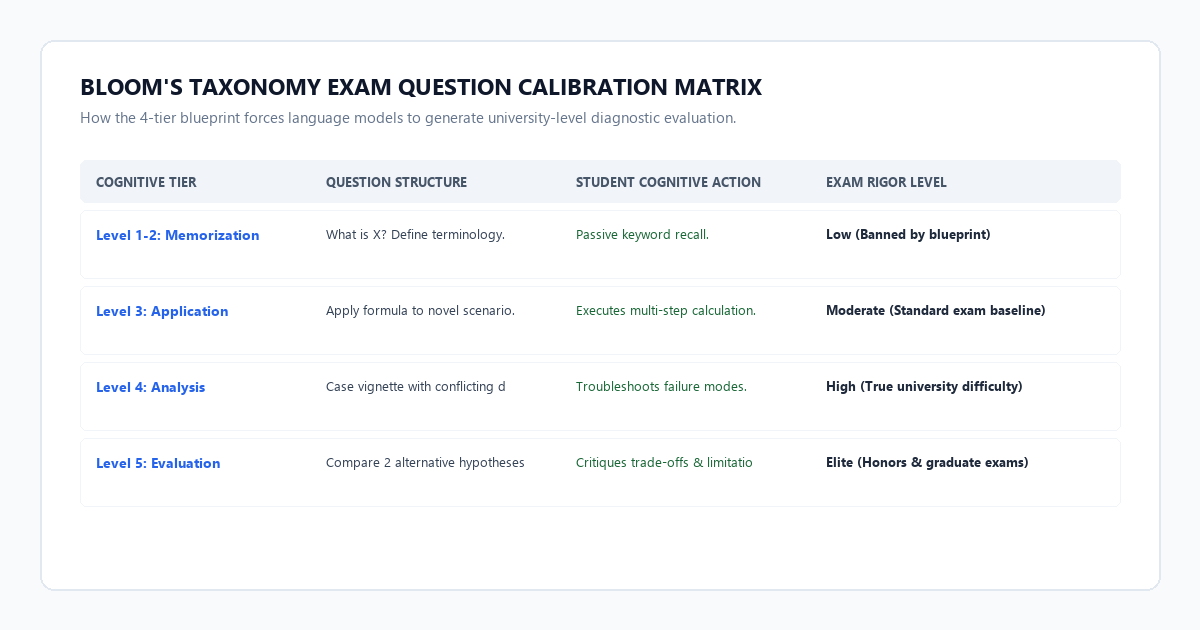
Interactive Self-Grading Markdown Format
When you run this prompt, the AI produces clean, interactive Markdown questions that you can paste directly into Obsidian, Notion, or any Markdown viewer. The answers are hidden under interactive HTML disclosure widgets (<details> tags) so you cannot accidentally spoil the correct answer while testing yourself.
Question 1: Metabolic Regulation
A 42-year-old patient presents with muscle weakness, exercise intolerance, and severe lactic acidosis following mild exertion. Serum pyruvate is elevated with normal mitochondrial Complex I–IV electron transfer rates. A defect in which enzyme is most consistent with these findings?
[ ] A) Citrate Synthase
[ ] B) Pyruvate Dehydrogenase Phosphatase
[ ] C) Isocitrate Dehydrogenase
[ ] D) Succinate Dehydrogenase
Reveal Diagnostic Answer & Rationales
Correct Answer: B) Pyruvate Dehydrogenase Phosphatase
Why B is correct: PDH phosphatase activates the pyruvate dehydrogenase complex by dephosphorylation. Deficiency locks PDH in an inactive state, shunting accumulating pyruvate into lactate via lactate dehydrogenase.
Why A is incorrect: Citrate synthase deficiency impairs acetyl-CoA entry into Krebs, but does not directly explain elevated pyruvate with normal electron transport rates.
Why C is incorrect: Isocitrate dehydrogenase acts downstream; it does not cause upstream pyruvate accumulation.
Why D is incorrect: Succinate dehydrogenase is Complex II of the electron transport chain, which was explicitly noted as normal.
Recommended Exam Calibration by Discipline
| Academic Domain | Target Cognitive Level | Question Construction Style | Primary Distractor Architecture |
|---|---|---|---|
| Medicine & Biology | Bloom's Level 4 (Analysis) | Patient case vignettes with labs | Confusable pathologies and similar lab profiles |
| Engineering & CS | Bloom's Level 4–5 (Evaluation) | Code snippets & system architectures | Off-by-one errors, race conditions, memory leaks |
| Law & Humanities | Bloom's Level 3–4 (Application) | Factual fact patterns & judicial tests | Minority rule exceptions and misapplied standards |
| Finance & Business | Bloom's Level 3 (Application) | Financial statements & unit metrics | Inverted discount rates and missed accruals |
Hardware and System Requirements Matrix
| Deployment Tier | Toolchain / Engine | System Requirements | Token Context Window | Privacy Level | Cost |
|---|---|---|---|---|---|
| Tier 1: Frontier Cloud Ingestion | Google AI Studio (Gemini Pro) | Any web browser, no GPU required | 2,000,000 tokens (~1,400 pages) | Zero-retention developer API | $0.00 |
| Tier 2: Reasoning Model API | Claude 3.5 Sonnet Console | Any web browser / internet connection | 200,000 tokens (~150 pages) | High analytical precision | $0.00 |
| Tier 3: Local LLM Engine | Ollama (llama3.3:70b / qwen2.5) |
High-end GPU (>=24GB VRAM) or Mac M2 Max | 32k to 128k tokens | 100% Offline Air-Gapped | $0.00 |
| Tier 4: Commercial EdTech | Quizlet Plus / StudyFetch / PrepAI | Cloud web app or mobile app | Restricted chunking (10–20 slides) | Cloud user tracking | $35-$96/yr |
The cognitive trap: 3 AI question failure modes and how to fix them
When generating exams with standard AI models, subtle prompt loopholes produce defective questions. Watch for these three traps:
1. The Trivial Definition Tell (Recall Bias)
The Failure Mode: Models default to the lowest cognitive energy state. Without constraints, they generate questions testing trivial vocabulary definitions: "What is the definition of osmosis?" This gives students 100% scores on practice tests while failing the actual exam.
The Fix: Enforce the "No Vocabulary" constraint: "Every question must present a novel scenario where the concept is applied to solve a practical or clinical problem. Explicitly forbid asking for definitions or terminology recitations."
2. The Length-Bias Answer Leak
The Failure Mode: Language models tend to make the correct answer significantly longer and more detailed than the distractors because they want to ensure technical accuracy. Astute students subconsciously identify choice (C) as correct simply because it is three times longer than the others.
The Fix: Include the length constraint: "All four answer options (A, B, C, D) must be approximately equal in length, word count, and grammatical syntax."
3. The "All of the Above" Crutch
The Failure Mode: Models frequently lean on "All of the above" or "None of the above" when they run out of plausible distractors. This allows students to identify the right choice by spotting just two partially true options.
The Fix: Explicitly prohibit these choices: "Never include 'All of the above' or 'None of the above' as an option. Every question must feature exactly four distinct, mutually exclusive choices."
Platform comparison: Quizlet Plus vs. PrepAI vs. Veylo Zero-Cost Engine
| Feature | Quizlet Plus ($36/year) | PrepAI ($180/year) | Veylo Zero-Cost Engine |
|---|---|---|---|
| Annual Subscription Cost | $35.99 / year | $180.00 / year | $0.00 forever |
| Question Volume Limit | Capped at 20 questions | Capped by monthly credits | Unlimited (50+ questions per deck) |
| Context Window Capacity | ~10–20 slides per upload | ~15 pages per document | 2,000,000 tokens (Gemini Pro) |
| Bloom's Cognitive Level | Recall / Memory (Levels 1–2) | Fact Extraction (Levels 1–2) | Application & Analysis (Levels 3–5) |
| Interactive Collapsible Keys | No (locked behind UI) | Basic score view | Collapsible <details> Markdown |
| Plausible Distractor Tuning | No (generic random words) | No (automated synonyms) | Enforced misconception modeling |
| Full Diagnostic Rationales | Basic flashcard flip | Premium tier only | Step-by-step why each choice is wrong |
Executive summary & action checklist
Generating high-yield practice exams from your course materials does not require paying $35 to $100 per year for commercial quiz platforms. Ingesting full slide decks into Google AI Studio's 2-million-token context window with Bloom's taxonomy constraints produces authentic, exam-caliber diagnostic tests in under a minute for $0.
- Ingest Whole Courses: Load complete 150-slide decks into 2M context windows without splitting or loss.
- Target Bloom's Levels 3–5: Force questions into application, clinical vignettes, and multi-step evaluation.
- Engineer Plausible Distractors: Require incorrect choices to model actual student misconceptions.
- Equalize Option Lengths: Ban length bias so correct answers cannot be guessed by length.
- Export Interactive Markdown: Use collapsible
<details>tags for self-grading without answer spoilers.